


|
|
||


|
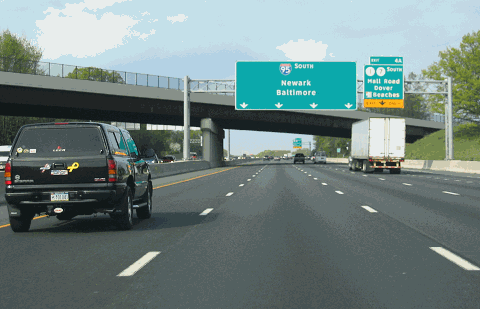
This 2010 photo shows the southbound Delaware Turnpike (I-95) at EXIT 4B (DE 58 / Churchmans Road) in Newark. A two-year, $52 million project to provide an additional travel lane in each direction was completed in 2008. (Photo by Steve Anderson.) |
||


|
Length: |
||
|
11.0 miles (17.7 kilometers) |
||

|
Passenger car cash toll: |
||
|
$4.00 (both directions) |
||
|
|
||

|
NON-STOP THROUGH THE NORTHEAST CORRIDOR: When the first Delaware Memorial Bridge opened in 1951, state officials planned a toll expressway to connect the new span with the Chesapeake Bay-William Preston Lane Jr. Memorial Bridge. The proposed "Maryland Expressway," which was to have been funded partially with proceeds from the Delaware Memorial Bridge tolls, was to be constructed parallel to US 301 through the Delmarva Peninsula. Plans for this toll road lay dormant for decades, though were revived in the 2010s to build a portion of this highway through Delaware. |
||
|
In 1955, state officials returned with a proposal for a new toll road, the Delaware Turnpike, which was to connect the Delaware Memorial Bridge with the Northeast Expressway, a toll road being developed by the state of Maryland. Together with the New Jersey Turnpike and other routes, a nonstop route would be provided from New York to Washington. Original plans called for the Delaware Turnpike to be financed by Delaware Memorial Bridge tolls, but soon after plans were announced, a new agency was created to fund, construct, and maintain the toll road. |
||
|
Over the years, the Delaware State Highway Department, and later, the Delaware Department of Transportation (DelDOT) made improvements to the original four-lane turnpike. Between 1968 and 1972, the turnpike was widened to six lanes, a project that was funded by turnpike tolls. Around this time, interchange tolls also financed the reconstruction of EXIT 1 (DE 896), EXIT 3 (DE 273) and EXIT 4 (DE 1 / DE 7 / DE 58). |
||

|
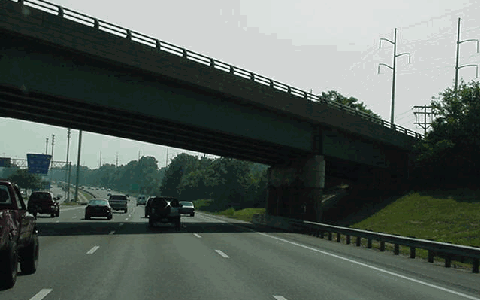
This 2000 photo shows the southbound Delaware Turnpike (I-95) approaching the Delaware House service area in Newark. This service plaza was rebuilt in 2009 and 2010. (Photo by Jim K. Georges.) |
||

|
OVERVIEW OF THE TOLL SYSTEM: The Delaware Turnpike opened with a ten-cent toll at the Newark barrier toll plaza, and five-cent tolls were collected at interchanges. In 1970, a failed one-month experiment used the honor system: drivers who lacked exact change for the automated toll machines were to mail tolls in preaddressed envelopes that were dispensed at the machines. The interchange tolls were removed in 1976, but evidence of the former tolls remains: ramps widen and straighten out in the area of the former tollbooths. In 1998, the Delaware Department of Transportation (DelDOT) expanded the Newark barrier toll plaza, adding lanes for the EZ-Pass interregional toll system. |
||
|
In the mid-2000s, Governor Ruth Ann Minner and DelDOT suggested public-private partnerships, including leasing the Delaware Turnpike, DE 1 Turnpike, and proposed US 301 Turnpike to private firms, to address DelDOT's budget shortfalls. Under such an arrangement, the state would receive a lump-sum payment while the private firms would collect tolls and maintain the highways. |
||
|
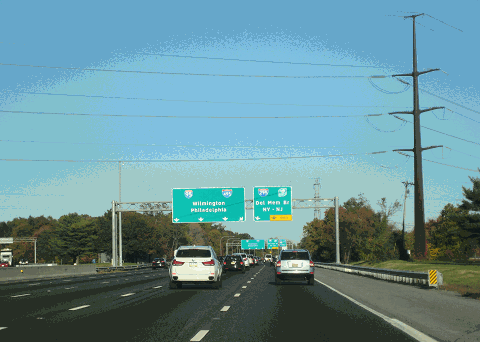
This 2015 photo shows the northbound Delaware Turnpike (I-95) approaching the split for I-95 / I-295 / I-495 in New Castle. (Photo by Steve Anderson.) |
||


|
SOURCES: "Delaware Seeks To Extend Tolls," The New York Times (10/04/1955); "New York-Washington Road Now Nonstop" by Ben A. Franklin, The New York Times (11/14/1963); "Kennedy, on Mason-Dixon Line, Opens Part of North-South Road" by Marjorie Hunter, The New York Times (11/15/1963); "Honor System Ending on Delaware Turnpike," The New York Times (7/04/1970); "Lawmakers Get To-Do List from DelDOT" by Jennifer Portman, The Wilmington News-Journal (5/17/2001); "Churchmans I-95 Span To Be Replaced" by Sean O'Sullivan, The Wilmington News-Journal (2/25/2004); "State Decides on a Fix for I-95 Traffic" by Sean O'Sullivan, The Wilmington News-Journal (5/11/2004); "Delaware Plans To Raise I-95 Tolls," The Baltimore Sun (6/30/2005); "I-95 Widening Project Added to Budget" by Patrick Jackson and Angie Basiouny," The Wilmington News-Journal (7/02/2005); "Delaware Reported Upping Tolls 50% To Balance Budget" by Peter Samuel, Toll Roads News (7/02/2005); "Churchmans Road Bridge Over I-95 Completed," The Wilmington News-Journal (12/08/2006); "DelDOT Considers Cashing In on Toll Roads" by Summer Harlow, The Wilmington News-Journal (1/07/2007); "Settlement Won't Speed I-95 Plan" by Angie Basiouny, The Wilmington News-Journal (1/11/2007); "Higher Tolls, Fees Start Today," The Wilmington News-Journal (10/01/2007); "Delaware Considering I-95 Toll Plaza Improvement" by Robert Thomson, The Washington Post (2/11/2009); "JFK Memorial Highway Improvement Program, Newark Toll Plaza / I-95," Delaware Department of Transportation (2010); "JFK Memorial Highway Improvement Program, SR 1 / I-95 Interchange," Delaware Department of Transportation (2010); Chris Blaney; Scott Kozel; Raymond C. Martin; Dan Mengel; Alex Nitzman; Scott Oglesby; Peter Samuel; Sandy Smith; Jeff Taylor; Ken Weaverling; William F. Yurasko. |
||

|
DELAWARE TURNPIKE LINKS: |
||

|
DELAWARE TURNPIKE CURRENT TRAFFIC CONDITIONS: |
||

|
DELAWARE TURNPIKE VIDEO LINKS: |
||

|
THE EXITS OF METRO PHILADELPHIA: |
||

|
|
||

|
Back to The Roads of Metro Philadelphia home page. |
||
|
Site contents © by Eastern Roads. This is not an official site run by a government agency. Recommendations provided on this site are strictly those of the author and contributors, not of any government or corporate entity. |
||
